










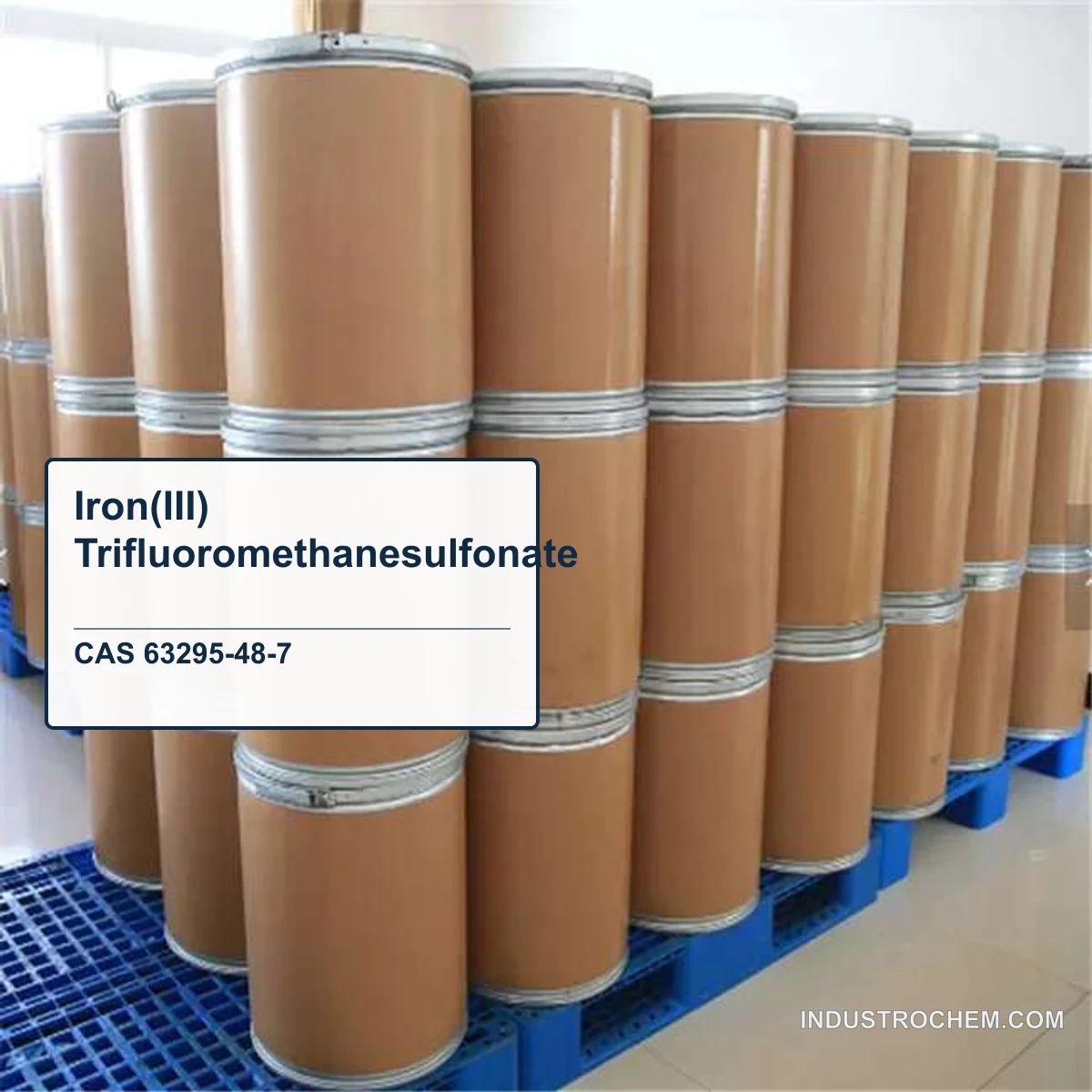
Iron(III) Trifluoromethanesulfonate, CAS 63295-48-7, is also known as iron(III) triflate or ferric triflate. It is an iron triflate compound used mainly as a Lewis-acid catalyst in organic synthesis. Confirm assay, hydration state, physical form and process requirements before requesting a quotation.
Iron(III) Trifluoromethanesulfonate CAS 63295-48-7
- CAS: 63295-48-7
- Synonyms: Iron(III) triflate; Ferric triflate; Iron(III) trifluoromethanesulfonate
- Molecular Formula: C₃F₉FeO₉S₃
- Grade: Confirm the current product-specific specification.
- Package: Confirm packaging for the offered form and destination requirements.
Product Description
Iron(III) Trifluoromethanesulfonate is also called iron(III) triflate or ferric triflate.
Molecular formula: C₃F₉FeO₉S₃.
CAS Number: 63295-48-7.
Molar mass: approximately 503.03 g/mol.
Catalytic-use context
- This material is an iron triflate compound that may be evaluated where Lewis-acid catalysis is required.
- Confirm suitability for any named pharmaceutical intermediate or specific reaction route with the current product-specific specification.
- Do not rely on generic yield, purity or scale-up figures; request the current product-specific specification for the intended process.
Process application boundary
- Application suitability depends on the buyer’s formulation or process and must be assessed against the current product-specific specification.
- Confirm suitability for biomass conversion, hydrodeoxygenation or fuel-precursor work with the current product-specific specification.
Specification and handling
- Confirm the current product-specific specification.
- Use the current product-specific SDS and specification to assess handling, storage and local regulatory suitability.
- Confirm package range, storage conditions, transport classification and production-origin information with the current product-specific specification and SDS.
FAQ - Technical & Supply Chain
-
Q:
What is Iron(III) Trifluoromethanesulfonate used for?
A: Iron(III) trifluoromethanesulfonate, also called iron(III) triflate or Fe(OTf)3, is used mainly as a Lewis-acid catalyst in organic synthesis. Typical applications include glycosylation reactions, preparation of 2,3-unsaturated O-glycosides, synthesis of beta-enamino ketones and esters, and selected C-H bond activation or oxidation processes. -
Q:
Is Iron(III) Trifluoromethanesulfonate CAS 63295-48-7 the same as iron(III) triflate?
A: Yes. CAS 63295-48-7 identifies iron(III) trifluoromethanesulfonate, commonly written as Fe(CF3SO3)3 or Fe(OTf)3 and also known as ferric triflate or iron(III) triflate. The same CAS number should not be used to imply a defined hydration state, assay, or physical grade; those must be confirmed from the supplier specification. -
Q:
What should be specified for Iron(III) Trifluoromethanesulfonate?
A: State the required assay method, hydration or moisture basis, appearance, iron oxidation-state limits and pack size, then identify the intended catalytic process. It is commonly a white to light-yellow, moisture-sensitive solid, and commercial technical material may be offered around 90% assay, so CAS identity alone is insufficient for lot approval. -
Q:
How should Iron(III) Trifluoromethanesulfonate be stored, handled, and transported?
A: It is generally soluble in water, methanol and acetonitrile and is moisture sensitive. Store it in a cool, dry, well-ventilated area under an inert atmosphere where applicable, keep the container tightly closed, and confirm the exact transport classification from the current product-specific safety information. Some commercial safety information documents list no UN number, so do not rely on that general statement; validate catalyst loading and activity on a representative lot before scale-up.
Ordering & Documentation
Key information for document requests, quotations, and supply planning.
Documents
Tell us which documents your procurement team needs. Before an order, we will check whether the quoted source can provide them for the offered lot.
Quotation
Send the CAS number, grade, quantity, packing preference and destination.
Sample & Supply
Ask whether samples, trial quantities or repeat orders are possible. We will check each request against the sourced product and current offer.
Storage & Shipping
Product-specific conditions are confirmed before order.