










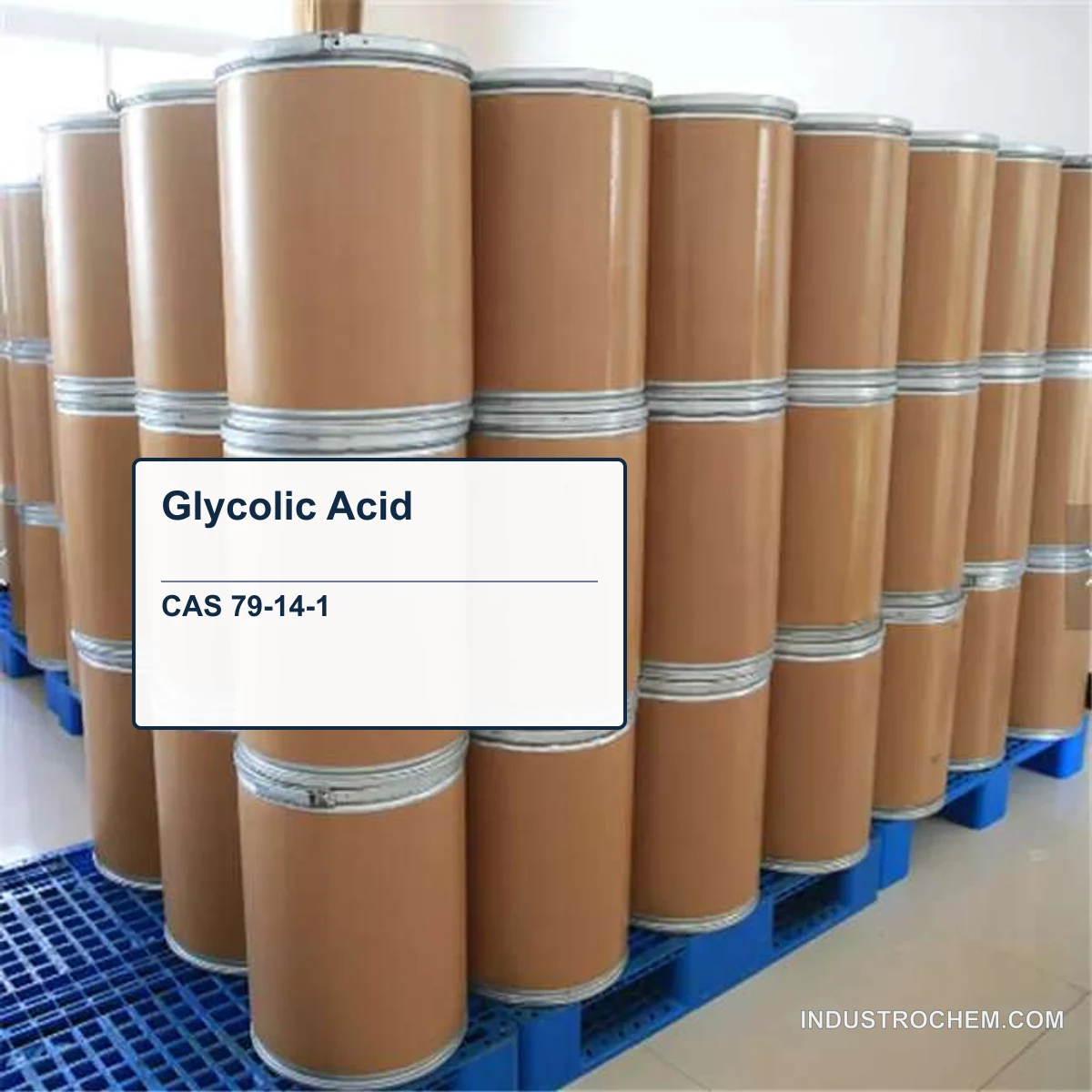
Glycolic Acid, also called Hydroxyacetic Acid, is an organic acid identified by CAS 79-14-1. Concentration, form, intended process, and material compatibility must be confirmed against current product-specific information. For an RFQ, state the intended use, required specification, quantity, packaging, destination, and document needs.
Glycolic Acid CAS 79-14-1
- CAS: 79-14-1
- Synonyms: Hydroxyacetic Acid; 2-Hydroxyacetic Acid; Hydroxyethanoic Acid; alpha-Hydroxyacetic Acid
- Einecs: 201-180-5
- Molecular Formula: C₂H₄O₃
- Grade: Confirm the current product-specific specification.
- Package: Confirm packaging requirements for the proposed material and destination.
Product Description
Glycolic Acid, also called Hydroxyacetic Acid, is an organic acid identified by CAS 79-14-1. Concentration, form, intended process, and material compatibility must be confirmed against current product-specific information.
Molecular formula: C₂H₄O₃.
Molar mass: 76.05 g/mol.
CAS Number: 79-14-1.
EC Number: 201-180-5.
Physical-property requirements must be confirmed against the current product-specific specification and applicable SDS.
Application context
Glycolic Acid, also called Hydroxyacetic Acid, may be evaluated for metal treatment, cleaning, or synthesis-related processes when concentration, formulation, and material compatibility are defined.
Do not infer low corrosivity, descaling performance, or cleaning safety from the CAS alone; evaluate under the actual process conditions.
Organic synthesis or dyeing use must be reviewed for the specific process and specification.
Do not describe Glycolic Acid as a sanitizer without product-specific evidence and regulatory review.
For electroplating use, define bath chemistry and compatibility requirements.
FAQ - Technical & Supply Chain
-
Q:
Is Glycolic Acid normally supplied neat or as a 70% aqueous solution?
A: Industrial Glycolic Acid is commonly traded as a 70% aqueous solution, while high-purity crystalline or other concentrations also exist. State acid concentration, free-acid or total-acid reporting basis, intended process and required grade because price and dosage depend on active content. -
Q:
Which specifications matter when purchasing industrial Glycolic Acid?
A: Confirm Glycolic Acid concentration and titration basis, free acid, color, density, formic and oxalic acids, formaldehyde where relevant, chloride, sulfate, iron and other metals required by the process. Cleaning, oilfield, electronics and personal-care uses have different impurity requirements. -
Q:
What is Glycolic Acid used for?
A: Glycolic Acid is evaluated for metal treatment, cleaning, descaling and synthesis-related processes where its acid strength and compatibility are suitable. Actual corrosivity, compatibility and cleaning performance must be assessed under the target concentration, temperature, contact time and substrate. -
Q:
What are the key physical properties and acid strength of Glycolic Acid?
A: Glycolic acid is a solid crystalline alpha-hydroxy acid with formula C2H4O3, molar mass about 76.05 g/mol, melting point commonly cited near 75-80 C and pKa around 3.83 at 25 C. It is highly water soluble, so confirm whether the offer is crystalline, a 70% aqueous solution, or another concentration because handling and physical properties differ. -
Q:
How should Glycolic Acid be stored and handled?
A: Store in tightly closed, corrosion-resistant containers in a cool, dry, ventilated area. Avoid freezing for liquid grades, protect high-purity solid from moisture, use acid-resistant equipment during transfer and follow the current safety information for PPE, ventilation and spill response.
Ordering & Documentation
Key information for document requests, quotations, and supply planning.
Documents
Tell us which documents your procurement team needs. Before an order, we will check whether the quoted source can provide them for the offered lot.
Quotation
Send the CAS number, grade, quantity, packing preference and destination.
Sample & Supply
Ask whether samples, trial quantities or repeat orders are possible. We will check each request against the sourced product and current offer.
Storage & Shipping
Product-specific conditions are confirmed before order.