










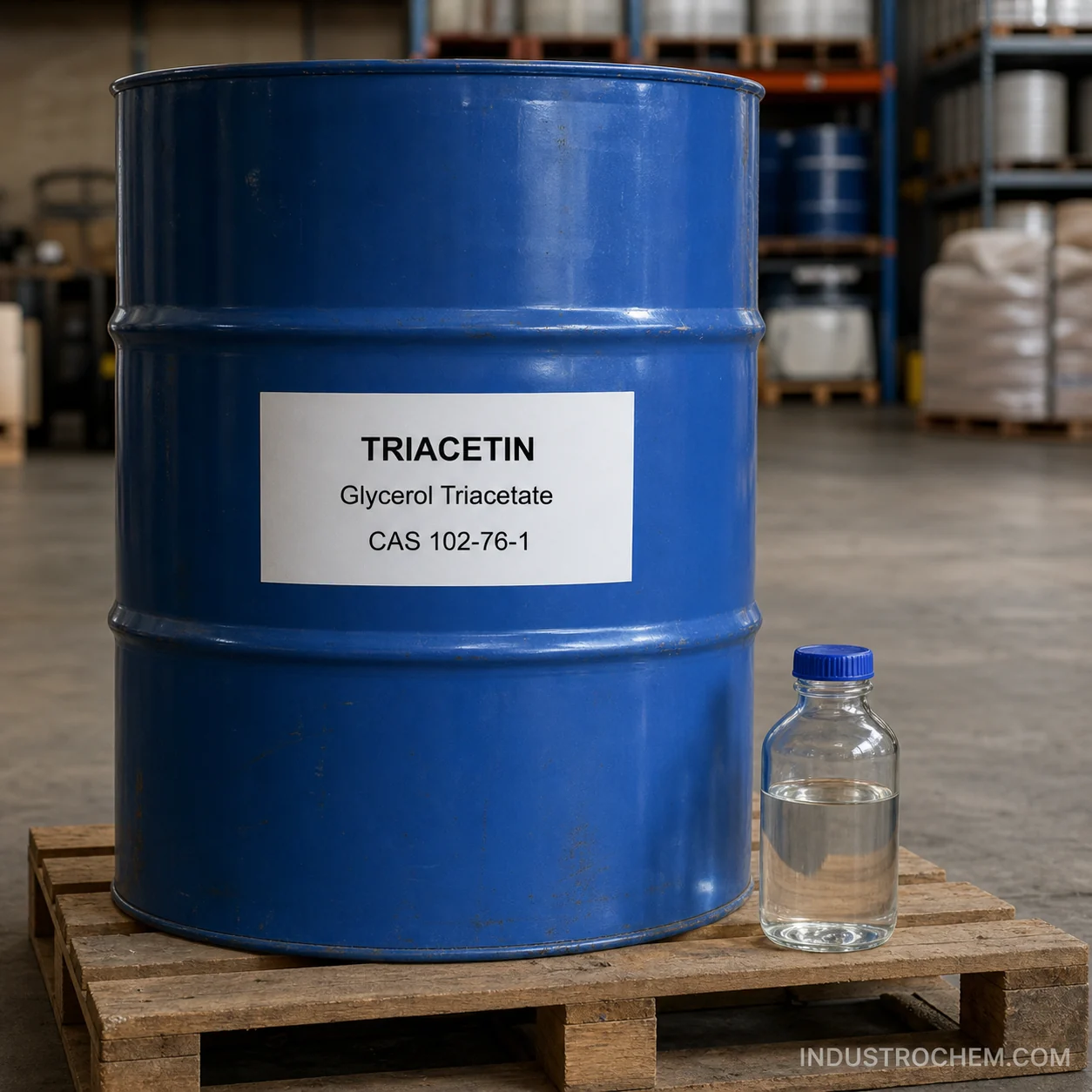
Triacetin, also called Glycerol Triacetate, is an acetate ester identified by CAS 102-76-1. It may be evaluated as a plasticizer or solvent in cellulose-acetate and other industrial formulations when the required specification is defined. For an RFQ, state the intended use, required specification, quantity, packaging, destination, and document needs.
Triacetin (Glycerol Triacetate) CAS 102-76-1
- CAS: 102-76-1
- Synonyms: Glycerol Triacetate; Glyceryl Triacetate; 1,2,3-Triacetoxypropane; Triacetyl Glycerine
- Einecs: 203-051-9
- Molecular Formula: C₉H₁₄O₆
- Grade: Confirm the current product-specific specification.
- Package: Confirm packaging requirements for the proposed material and destination.
Product Description
Triacetin, also called Glycerol Triacetate, is an acetate ester identified by CAS 102-76-1. It may be evaluated as a plasticizer or solvent in cellulose-acetate and other industrial formulations when the required specification is defined.
Molecular formula: C₉H₁₄O₆.
Molar mass: 218.20 g/mol.
Physical-property requirements must be confirmed against the current product-specific specification and applicable SDS.
CAS Number: 102-76-1.
Industrial evaluation
Fragrance formulations: confirm the applicable use context and specification.
Solvent use: assess compatibility with the target formulation and process.
Synthesis use: define the intended reaction or process before evaluation.
Regulated-use suitability must be confirmed separately with current product-specific documentation.
Casting use: do not assume a fixed role; define the process and required specification.
Ink or coating formulations: evaluate compatibility under the target process conditions.
Cellulose acetate: assess plasticizer compatibility against the required specification.
FAQ - Technical & Supply Chain
-
Q:
What is Triacetin CAS 102-76-1?
A: Triacetin, also called Glycerol Triacetate or Glyceryl Triacetate, is the triester of glycerol and acetic acid. It has CAS 102-76-1, EINECS 203-051-9, molecular formula C9H14O6 and molecular weight about 218.20. It is normally a colorless to pale, low-odor oily liquid with a boiling point around 258-260 deg C and density around 1.16 g/cm3. -
Q:
Are Triacetin, Glycerol Triacetate and Glyceryl Triacetate the same material?
A: Yes. These names all identify CAS 102-76-1, but they do not define a commercial grade. Food-additive, pharmaceutical, cosmetic and tobacco-filter grades may have different assay bases, monograph limits and documentation, so the intended application should be stated when requesting a quotation. -
Q:
What is Triacetin used for?
A: Triacetin is used as a food-additive solvent and humectant, a pharmaceutical excipient and film-coating plasticizer, a fragrance and cosmetics solvent, and a plasticizer for cellulose acetate including cigarette filters. It is also evaluated as a biodegradable or hydrophilic plasticizer and solvent in coatings, inks and other polymer systems. -
Q:
Which specifications should be confirmed for Triacetin?
A: Key parameters are assay, water, acidity, color, density, refractive index and distillation range. Typical values include assay not less than 99%, density about 1.155-1.165 at 20 deg C, refractive index about 1.429-1.432 and low Pt-Co color, but food and pharmaceutical grades may require compendial or regulatory limits. -
Q:
How should Triacetin be stored and handled?
A: Store Triacetin in tightly closed, compatible containers in a cool, dry and ventilated area away from strong oxidizers, heat and ignition sources. Keep containers sealed when not in use to avoid moisture ingress and contamination, and confirm packaging, unloading and safety requirements before bulk transfer.
Ordering & Documentation
Key information for document requests, quotations, and supply planning.
Documents
Tell us which documents your procurement team needs. Before an order, we will check whether the quoted source can provide them for the offered lot.
Quotation
Send the CAS number, grade, quantity, packing preference and destination.
Sample & Supply
Ask whether samples, trial quantities or repeat orders are possible. We will check each request against the sourced product and current offer.
Storage & Shipping
Product-specific conditions are confirmed before order.