









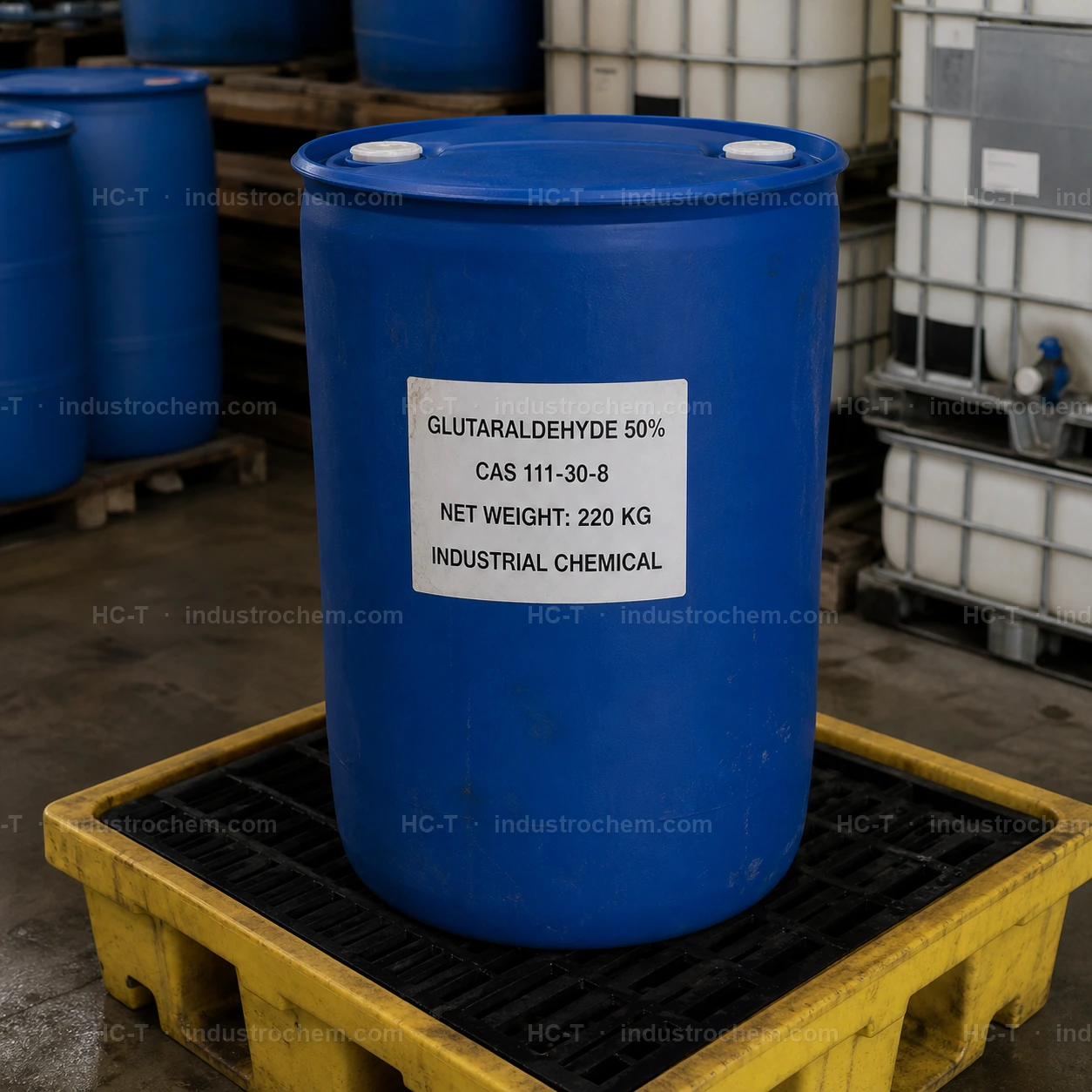
Glutaraldehyde (glutaral), CAS 111-30-8, is a non-oxidizing active for industrial water, oilfield and pulp-and-paper microbiological-control programmes. It is supplied as an aqueous grade defined by active concentration and approved use, with COA, TDS and SDS for the supplied product.
Glutaraldehyde CAS 111-30-8
- CAS: 111-30-8
- Synonyms: Glutaraldehyde; Pentanedial; Glutaral; GDA
- Einecs: 203-856-5
- Molecular Formula: C5H8O2
- Grade: Industrial water-treatment grade; aqueous active concentration specified by application
- Package: HDPE drums or IBCs for aqueous solution grades; shipment classification and pack must follow the current SDS
- Appearance: Clear to pale-yellow aqueous liquid
- Active concentration: Selected aqueous grade; confirm against the batch COA
- Molecular formula: C5H8O2
- Primary use: Non-oxidizing industrial microbiological control
- Critical checks: Active content, pH, density, storage and regulatory suitability
Product Description
Glutaraldehyde (CAS 111-30-8) is an aldehyde active used in industrial microbiological-control formulations. Water-treatment buyers generally select an aqueous grade according to active concentration, process water, dosing equipment and the regulatory status of the intended use. It should not be described as a universal disinfectant without reference to the approved application and local label requirements.
Applications
- Industrial cooling-water systems and process-water circuits where non-oxidizing microbial control is required.
- Oilfield injection, produced-water and storage applications, subject to programme and regional approvals.
- Pulp and paper systems for slime-control programmes where the finished formulation is approved for the use.
- Industrial preservation and cross-linking applications when the product grade is technically and legally suitable.
Specification points
Confirm the active concentration, pH, appearance, density, free-aldehyde test method, storage window and container compatibility. THPS and glutaraldehyde serve different treatment roles and must be selected by the microbial-control programme, not by a generic biocide comparison.
Safe industrial use
Use only in approved industrial applications. Personnel protection, ventilation, storage, transport classification and waste handling must follow the current SDS, the destination regulations and the finished-formulation instructions.
FAQ - Technical & Supply Chain
-
Q:
What is the difference between 25% and 50% glutaraldehyde solutions?
A: The active concentration affects transport, storage volume, dosing calculations and final formulation design. The correct grade should be chosen against the approved use, dosing system, local registration and the active-content basis stated in the purchase specification. -
Q:
Can one glutaraldehyde dose be stated for every water system?
A: No. Dose depends on microbial load, water chemistry, contact time, system volume, biofilm condition and the approved label or programme. Site trials and the finished water-treatment formulation determine the operational dose. -
Q:
What must be confirmed before an industrial glutaraldehyde shipment?
A: Confirm active concentration, destination-use approval, pH and density requirements, packaging, transport classification, shelf-life controls and the latest SDS. These controls are essential because glutaraldehyde is a reactive industrial active.
Ordering & Documentation
Key information for document requests, quotations, and supply planning.
Documents
COA, TDS, SDS/MSDS and packing details are available on request.
Quotation
Send the CAS number, grade, quantity, packing preference and destination.
Sample & Supply
Support is available for samples, trial orders, bulk and repeat supply.
Storage & Shipping
Product-specific conditions are confirmed before order.
