










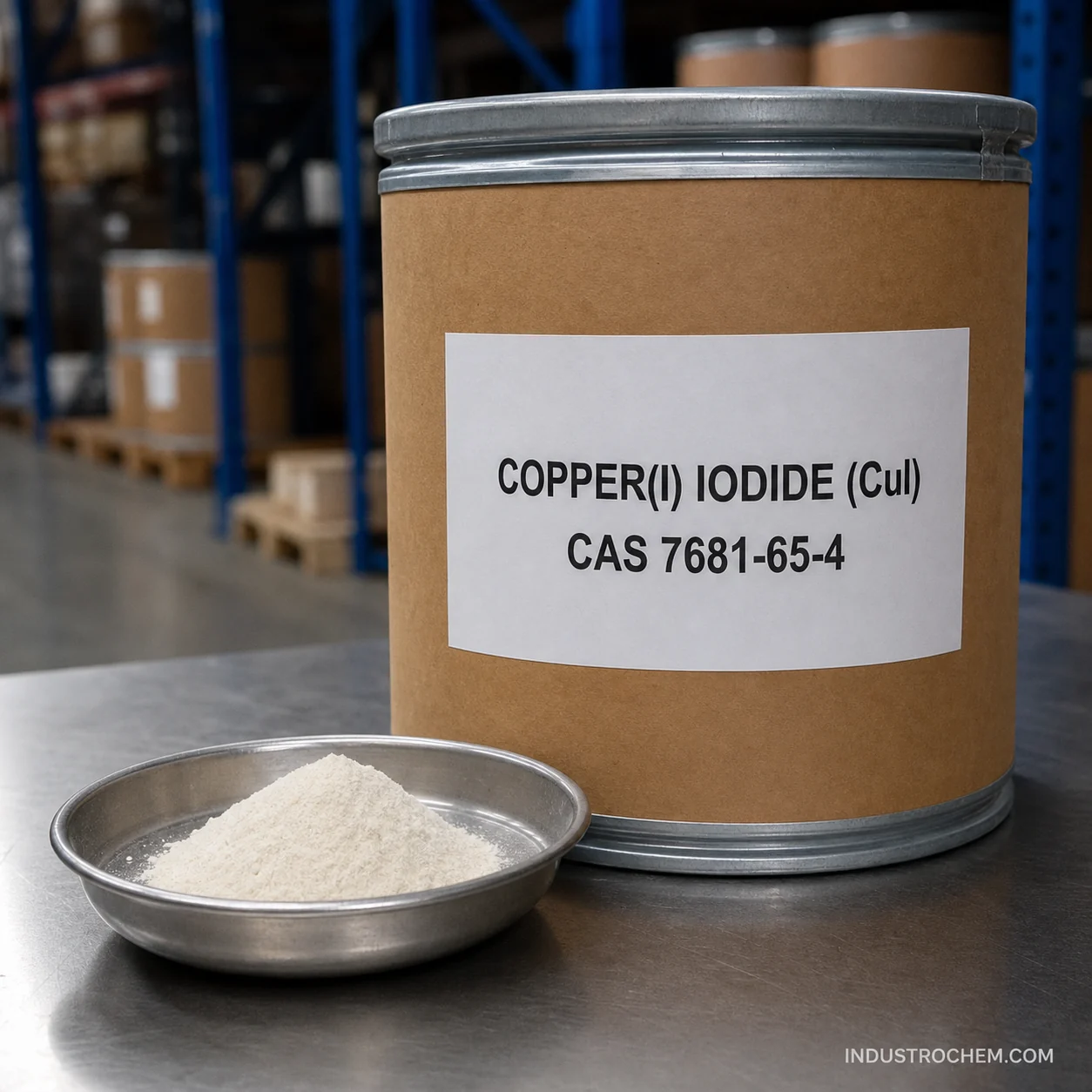
Cuprous Iodide (CAS 7681-65-4) is a dense, white to brownish inorganic powder consisting of copper(I) cations and iodide anions, primarily utilized as a highly effective catalyst in organic synthesis and a heat stabilizer in nylon polymers. This Copper(I) iodide compound functions as a crucial reagent in Sandmeyer reactions and Ullmann condensations to facilitate carbon-heteroatom bond formation, while also serving as a key additive in Cuprous monoiodide formulations to enhance the thermal durability of industrial polyamides. To support industrial-scale requirements, we provide bulk supply with competitive factory pricing and ensure rigorous quality control through customized specifications alongside standard technical documentation, including MSDS, TDS, COA.
Cuprous Iodide CAS 7681-65-4
- CAS: 7681-65-4
- Synonyms: Copper(I) iodide, Cuprous monoiodide, Copper monoiodide, Copper iodide (CuI)
- Einecs: 231-674-6
- Molecular Formula: CuI
- Grade: Industrial grade 99%
- Package: 200kg iron drum or 50kg plastic drum packing
Product Description
Cuprous iodide, also written copper iodide (due to Cu2+The oxidation potential of is greater than I2, so CuI is not present2), is a kindinorganic compound, the chemical formula is CuI, molecular weight 190.45, white or brownish-white cubic crystals or dense powder, easy to decompose into brownish-yellow when exposed to light. Insoluble in water and ethanol, soluble inConcentrated sulfuric acidand hydrochloric acid, which is also soluble in liquid ammonia,Potassium iodide、potassium cyanidesolution. Produced by reacting with sodium hydroxideCurous oxide、Sodium iodideand water.
Alias:copper iodide; Copper(I) iodide; Copper iodide
chemical formula:CuI
molecular weight:190.4505
CAS login number:7681-65-4
EINECS login number:231-674-6
Melting point:605 ℃
Boiling point:1336 ℃
Appearance:White or brownish-white cubic crystals or dense powder
Applications:
It can be used as an organic synthesis catalyst, resin modifier,artificial rainfallagents, anode ray tube coverings, andAdd iodized saltSource of iodine in . Cerium is present in the 1,2- or 1,3-diamine ligand, and cuprous iodide can catalyze brominated aromatic hydrocarbons and brominationheterocyclic compoundsandVinyl bromideTransform into correspondenceiodidereaction. The reaction is generally inDioxanesolvent, toSodium iodideAs an iodination reagent.
Aromatic iodide is generally more active than its counterparts chloride and iodide, so cuprous iodide can catalyze a series of thingsHalogenated hydrocarbonsinvolvedCoupling reactionsFor exampleHeck reaction, Stille reaction, Suzuki reaction, and Ullmann reaction. 2-bromo-1-octen-3-ol and 1-nonylene are presentBistriphenylphosphorus palladium dichloride, cuprous chloride and diethylamineWhen present, a coupling reaction occurs to produce 7-methylene-8-hexadecarbon-6-ol.
FAQ - Technical & Supply Chain
-
Q:
Is Cuprous Iodide (CAS 7681-65-4) chemically distinct from Copper(II) Iodide?
A: Yes, this substance is the stable univalent copper salt (CuI), distinct from divalent copper iodide which is generally unstable and decomposes spontaneously under standard conditions. -
Q:
What is the primary role of this material in chemical manufacturing?
A: It is typically applied as a catalyst for various coupling reactions involving aryl halides and as a stabilizing agent to prevent oxidative degradation in polyamide resin production.
Documents and Product Support
For product review and sourcing evaluation, supporting documents can be coordinated according to the product type, inquiry stage, and order requirements.
- COA for batch-based quality reference
- TDS for key physical and chemical information
- SDS / MSDS for handling, storage, and safety reference
- Packing information for sample, trial, and bulk orders
- Technical communication based on application and specification requirements
Information to Confirm Before Quotation
Clear sourcing information helps reduce specification mismatch and allows a more accurate quotation before sample or bulk order discussion.
- Product name and CAS number
- Application or intended end use
- Required purity, grade, or specification
- Sample quantity, trial order, or bulk demand
- Preferred packing form or net weight
- Destination country or port
- Required documents or compliance expectations
Packaging, Storage, and Handling Notes
Packaging form, storage conditions, shelf life, and shipment arrangements should be confirmed according to the product characteristics, package size, and destination requirements.
Before order confirmation, buyers are advised to review the corresponding product documents and confirm whether any special storage, labeling, or handling requirements apply.
Sample, Bulk Order and Repeat Supply Support
Support can be arranged for sample discussion, bulk supply planning, packaging confirmation, and routine sourcing communication based on the actual product and order requirements.
For repeat-use formulations or long-term procurement plans, buyers may discuss specification consistency, packaging preferences, delivery expectations, and document coordination in advance.


