










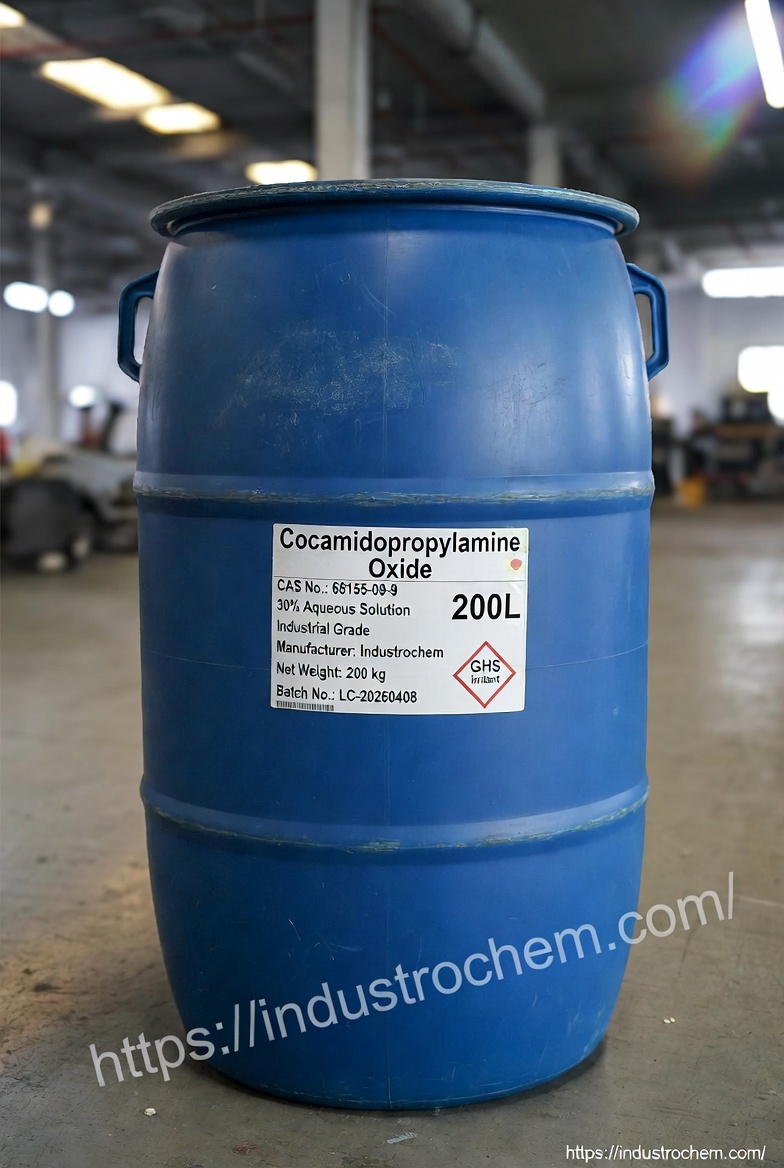
Cocamidopropylamine Oxide (CAO), also called cocamidopropyl dimethylamine oxide, CAS 68155-09-9, a coconut-derived amine oxide surfactant supplied as a pale yellow to colorless liquid, is positioned for foam boosting, foam stabilization, viscosity building, and mildness. Confirm the required active content and grade, then request a quotation with COA/TDS/SDS for bulk supply.
Cocamidopropylamine Oxide (CAO) CAS 68155-09-9
- CAS: 68155-09-9
- Synonyms: Amides, coco, N-[3-(dimethylamino)propyl], N-oxides; Cocamidopropyl Dimethylamine Oxide
- Einecs: 268-938-5
- Grade: Personal care / detergent grade
- Package: Standard export packaging
Product Description
Cocamidopropylamine Oxide (CAO) CAS 68155-09-9 is a coconut-derived amine oxide surfactant with EC 268-938-5.
Synonyms: Cocamidopropyl dimethylamine oxide; Amides, coco, N-[3-(dimethylamino)propyl], N-oxides.
CAS: 68155-09-9.
Molecular formula: Not applicable (coconut fatty acid amide mixture).
It is commonly supplied as a pale yellow to colorless liquid.
It is an amine oxide surfactant based on a cocamidopropyl dimethylamine oxide structure.
It is positioned as a foam booster, foam stabilizer, viscosity builder, and mildness aid.
It is commonly used in shampoo, facial cleanser, foaming cleansing gel, body wash, shower gel, and makeup remover.
It is usually selected as a co-surfactant to support foam, mildness, and formulation compatibility.
It can help reduce the harshness of primary anionic surfactants while maintaining foam quality.
Confirm active content, appearance, pH, and related impurities for the chosen grade.
Check compatibility with the primary surfactant system and final pH target.
Store in tightly closed containers in a cool, dry, well-ventilated area away from moisture and heat.
Use appropriate PPE and prevent spills or contamination.
Confirm packaging suitable for the liquid form and order quantity, and follow the current SDS.
Every batch is checked for active content, appearance, pH, and related impurities, with COA/TDS/SDS supplied per grade.
Confirm active content, packaging, and grade as required.
The page is an RFQ entry point and does not state stock, price, MOQ, or fixed lead time.
For an RFQ, state the intended application, required grade, quantity, packaging, destination, and document needs.
FAQ - Technical & Supply Chain
-
Q:
What is Cocamidopropylamine Oxide CAS 68155-09-9?
A: Cocamidopropylamine Oxide, also called cocamidopropyl dimethylamine oxide, is a coconut-derived amine oxide surfactant with CAS 68155-09-9 and EC No. 268-938-5. It is commonly supplied as a pale yellow to colorless liquid for use in cleansing and detergent formulations. -
Q:
What are the main applications of Cocamidopropylamine Oxide?
A: It is used in shampoo, facial cleanser, foaming cleansing gel, body wash, shower gel, makeup remover, and household or institutional liquid detergent systems. It is usually selected as a co-surfactant to support foam, mildness, and formulation compatibility. -
Q:
What functions does Cocamidopropylamine Oxide provide in formulations?
A: It mainly provides foam boosting, foam stabilization, viscosity building, cleansing support, and conditioning. In suitable formulations it can also help reduce the harshness of primary anionic surfactants while maintaining foam quality. -
Q:
What is the common supply form, active content, and pH of Cocamidopropylamine Oxide?
A: Commercial Cocamidopropylamine Oxide is usually a water-soluble aqueous liquid with active content around 30%, though some grades are in the 31-35% range. pH can vary by grade, with examples around 5.0-7.0 for 1% solution or 6.0-9.0 depending on the supplier specification, so the selected grade should be confirmed. -
Q:
How is Cocamidopropylamine Oxide different from Lauramine Oxide or Cocamidopropyl Betaine?
A: All are mild amphoteric-type or amine-oxide surfactants, but Cocamidopropylamine Oxide has a cocamidopropyl dimethylamine oxide structure, while Lauramine Oxide is a lauryl dimethylamine oxide and Cocamidopropyl Betaine is a betaine. They can differ in foam, viscosity response, conditioning, and pH behavior, so they should be selected by application testing rather than used as automatic substitutes.
Ordering & Documentation
Key information for document requests, quotations, and supply planning.
Documents
Tell us which documents your procurement team needs. Before an order, we will check whether the quoted source can provide them for the offered lot.
Quotation
Send the CAS number, grade, quantity, packing preference and destination.
Sample & Supply
Ask whether samples, trial quantities or repeat orders are possible. We will check each request against the sourced product and current offer.
Storage & Shipping
Product-specific conditions are confirmed before order.

