









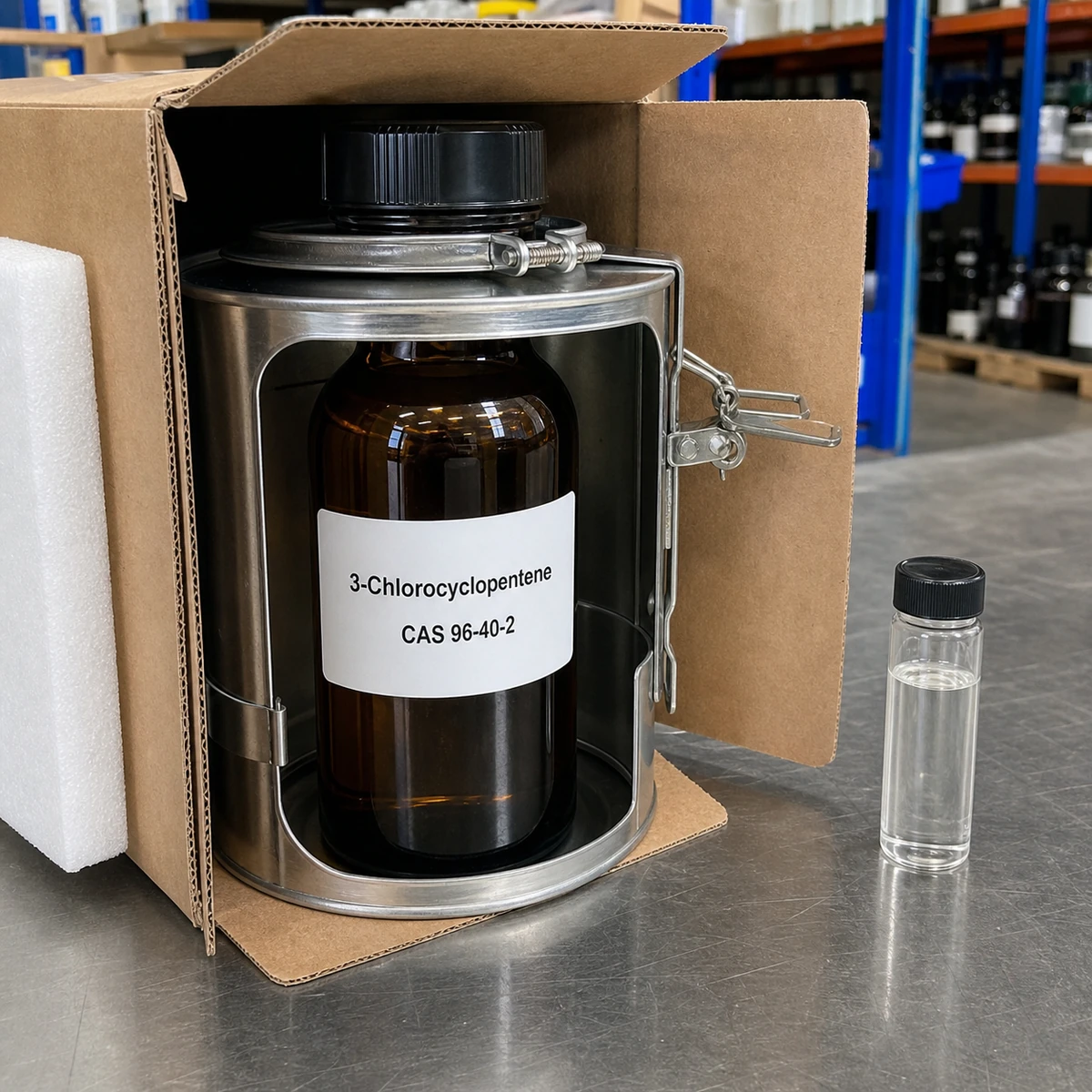
3-Chlorocyclopentene, also called 3-chlorocyclopent-1-ene or cyclopent-2-enyl chloride, CAS 96-40-2, is an allylic cyclic chloride with molecular formula C₅H₇Cl and molecular weight 102.56 g/mol. It combines an alkene with an allylic carbon–chlorine bond and may undergo substitution, elimination, addition or rearrangement depending on conditions. Buyers should define GC assay, positional isomers, acidity, residual precursors, stabilizer status and storage history rather than assume that a generic cold-storage statement applies to every offered grade.
3-Chlorocyclopentene CAS 96-40-2
- CAS: 96-40-2
- Synonyms: 3-Chlorocyclopentene, 3-Chlorocyclopent-1-ene, Cyclopent-2-enyl chloride, Allylic cyclopentenyl chloride
- Molecular Formula: C₅H₇Cl
- Grade: Confirm the supplied form or concentration, assay, reactive impurities, stabilizer or inhibitor status, storage controls and handling requirements against the current COA and SDS.
- Package: State required quantity and destination; confirm the approved container or cylinder, inerting or stabilizer needs, closure or valve, fill quantity, temperature controls and dangerous-goods requirements against the SDS.
Product Description
Identity and physicochemical profile
| Item | Technical guidance |
|---|---|
| Product identity | 3-Chlorocyclopentene; 3-chlorocyclopent-1-ene |
| CAS / List number | 96-40-2 / 887-179-6 |
| Formula / molecular weight | C₅H₇Cl / 102.56 g/mol |
| Functional character | Allylic chloride and cyclic alkene with condition-dependent substitution, elimination and addition behavior |
| Key purchase controls | Identity, GC assay, positional isomers, residual cyclopentene derivatives, acidity, color, stabilizer and storage history |
Applications and grade selection
3-Chlorocyclopentene may be evaluated in allylic substitution, addition, coupling and cyclic-intermediate synthesis. Reaction outcome depends on nucleophile, catalyst, solvent, temperature and isomer profile, so performance should be confirmed in the intended route.
- Agree the GC method and limits for positional isomers, residual precursors and degradation products.
- Confirm stabilizer identity, storage temperature, headspace and retest requirements for the actual grade.
- Run a representative reaction to compare conversion, selectivity and downstream impurity carryover.
Storage and handling
Keep the product sealed in compatible packaging under the temperature, light and atmosphere conditions stated in the current SDS and COA. Control ignition sources and avoid incompatible bases, oxidizers and moisture.
Safety, documentation and procurement
Handle as a volatile, flammable and reactive chlorinated intermediate using ventilation and suitable personal protection. Procurement should state specification, stabilizer needs, quantity, package, destination and dangerous-goods requirements.
FAQ - Technical & Supply Chain
-
Q:
Can 3-Chlorocyclopentene be identified by the formula C5H7Cl alone?
A: No. C5H7Cl can represent different chlorocyclopentene structures. CAS 96-40-2 identifies the allylic chloride also written as 3-chloro-1-cyclopentene. Confirm the complete name, CAS number, structure and an agreed GC or spectral identity method rather than matching by formula alone. -
Q:
What should a purchase specification for 3-Chlorocyclopentene include?
A: Define GC assay, positional isomers, water, acidity, color or appearance, residual cyclopentene derivatives and any process-specific impurity limits. State whether a stabilizer is required and, if present, its identity and level. Quantity, packing, storage conditions and batch analytical evidence should accompany the inquiry.
Ordering & Documentation
Key information for document requests, quotations, and supply planning.
Documents
COA, TDS, SDS/MSDS and packing details are available on request.
Quotation
Send the CAS number, grade, quantity, packing preference and destination.
Sample & Supply
Support is available for samples, trial orders, bulk and repeat supply.
Storage & Shipping
Product-specific conditions are confirmed before order.