









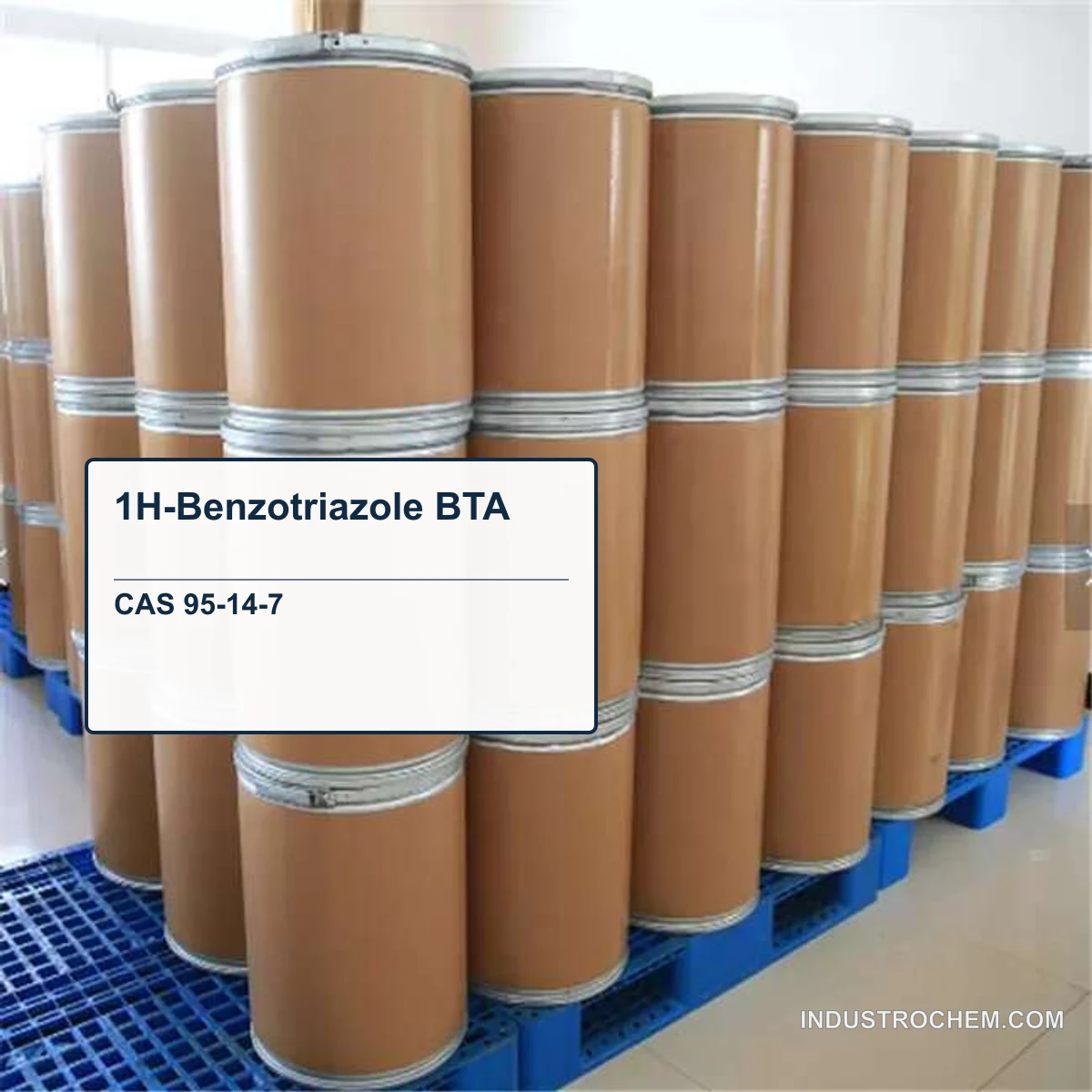
1H-Benzotriazole (BTA) CAS 95-14-7 is a heterocyclic corrosion inhibitor used mainly for copper and copper-alloy passivation in water treatment, antifreeze, and lubricant systems. Confirm appearance, assay, moisture, intended system, quantity, packaging, and SDS before quotation.
1H-Benzotriazole (BTA) CAS 95-14-7
- CAS: 95-14-7
- Synonyms: Benzotriazole, BTA, 1,2,3-Benzotriazole, Azimidobenzene, 1,2,3-Triazaindene
- Molecular Formula: C₆H₅N₃
- Grade: Confirm the current product-specific specification.
- Package: Confirm packaging requirements with quantity, destination, and handling needs.
Product Description
1H-Benzotriazole (BTA) is a heterocyclic corrosion inhibitor identified by CAS 95-14-7.
Synonyms: Benzotriazole; BTA; 1,2,3-Benzotriazole; Azimidobenzene; 1,2,3-Triazaindene.
CAS: 95-14-7.
Molecular formula: C₆H₅N₃.
Confirm assay, appearance, melting range, moisture or loss on drying, color, related isomers or impurities, application, quantity, packaging, and documents before purchase.
It is mainly evaluated as a corrosion inhibitor or passivator for copper and copper alloys in cooling water, antifreeze, deicing fluids, metalworking fluids, and lubricants.
Confirm the current product-specific specification.
Confirm packaging requirements with quantity, destination, and handling needs.
Document requirements should be confirmed from the current specification, SDS, COA, or other product-specific files.
Regulated-use suitability must be confirmed separately with current product-specific documentation.
The page is an RFQ entry point and does not state stock, price, MOQ, or fixed lead time.
For an RFQ, state the intended use, required specification, quantity, packaging, destination, and document needs.
FAQ - Technical & Supply Chain
-
Q:
Is BTA the same as 1H-Benzotriazole?
A: Yes. BTA is the common abbreviation for 1H-Benzotriazole, also called Benzotriazole or 1,2,3-Benzotriazole. The CAS number is 95-14-7, and the compound has molecular formula C₆H₅N₃. -
Q:
Which specifications matter for Benzotriazole?
A: Compare assay, appearance, melting range, moisture or loss on drying, color and related isomers or impurities. Typical BTA is a white to light yellow crystalline solid with a melting range around 96-100 °C, but the required limits depend on whether it is used as a corrosion inhibitor or as a synthesis intermediate. -
Q:
What is 1H-Benzotriazole used for?
A: BTA is used mainly as a corrosion inhibitor or passivator for copper and copper alloys in circulating cooling water, antifreeze, aircraft deicing fluids, metalworking fluids and lubricants. It is also used in water treatment, photographic restrainers, analytical silver testing, and as an intermediate or UV-related stabilizing component in selected formulations. -
Q:
How should BTA be stored and handled?
A: Store in tightly closed containers in a cool, dry, ventilated area away from heat, ignition sources, strong oxidizers and incompatible materials. Minimize dust generation, avoid inhalation and skin or eye contact, and use adequate ventilation and appropriate chemical protective equipment. -
Q:
What are the key physical properties of 1H-Benzotriazole?
A: BTA is a white to light yellow crystalline solid with molecular formula C₆H₅N₃ and molar mass about 119.13 g/mol. It typically melts around 96-100 °C, has density about 1.34-1.36 g/cm³ and limited water solubility of roughly 19-25 g/L, while being soluble in alcohol, benzene, toluene, chloroform and DMF.
Ordering & Documentation
Key information for document requests, quotations, and supply planning.
Documents
Tell us which documents your procurement team needs. Before an order, we will check whether the quoted source can provide them for the offered lot.
Quotation
Send the CAS number, grade, quantity, packing preference and destination.
Sample & Supply
Ask whether samples, trial quantities or repeat orders are possible. We will check each request against the sourced product and current offer.
Storage & Shipping
Product-specific conditions are confirmed before order.