










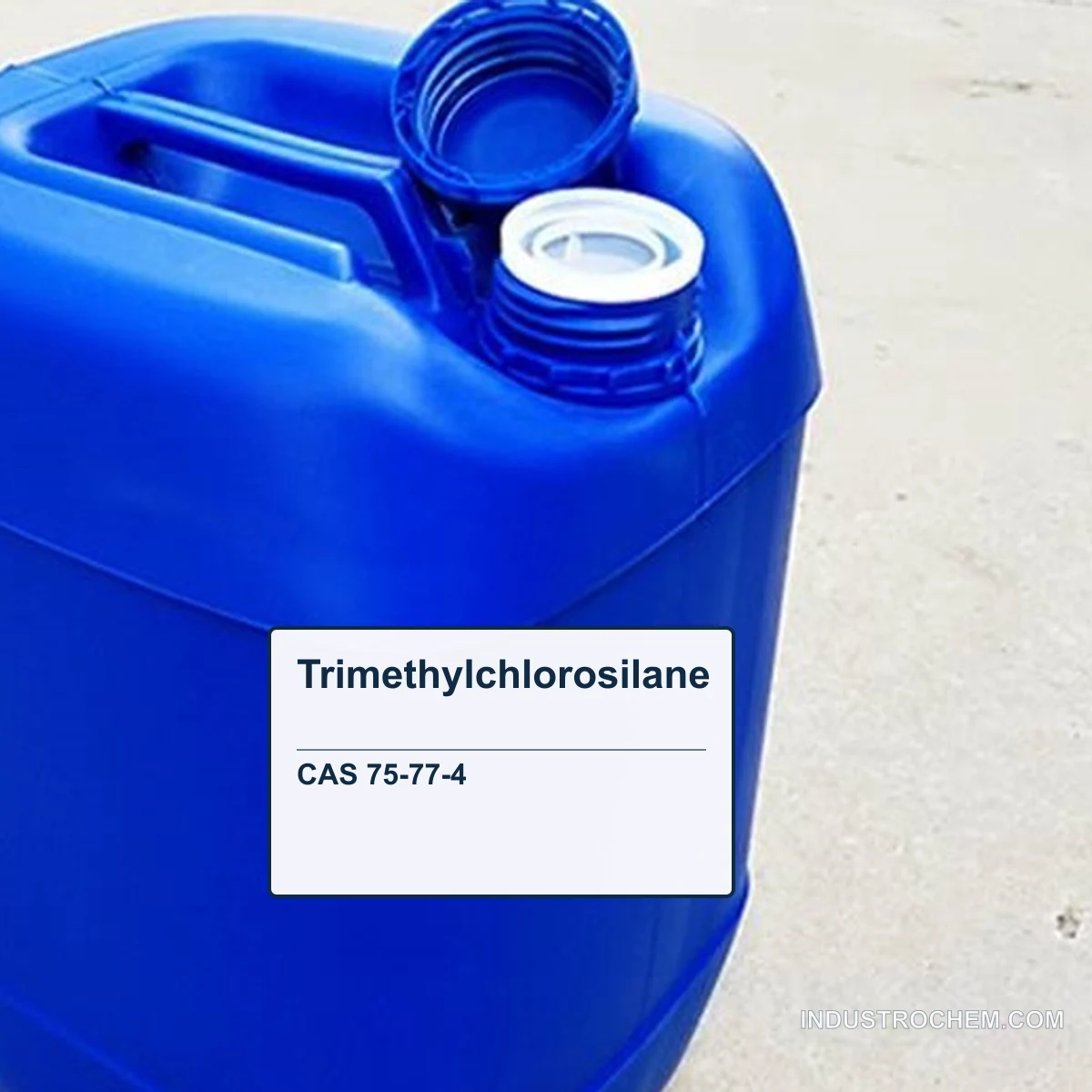
Trimethylchlorosilane (TMCS), CAS 75-77-4, is also known as chlorotrimethylsilane or trimethylsilyl chloride. It is a low-molecular-weight organosilicon reagent used in silylation and organosilicon synthesis. Confirm water-sensitive handling, required specification, quantity, packaging, destination and document needs before quotation.
Trimethylchlorosilane (TMCS) CAS 75-77-4
- CAS: 75-77-4
- Synonyms: Chlorotrimethylsilane; Trimethylsilyl chloride; TMCS; TMSCl
- Einecs: 200-900-5
- Molecular Formula: C₃H₉ClSi
- Grade: Confirm the current product-specific specification.
- Package: Confirm packaging for the offered material and destination requirements.
Product Description
Trimethylchlorosilane (TMCS) is an organosilicon reagent with a reactive silicon-chlorine bond, used in silylation and other controlled organosilicon transformations.
Alternative names: Chlorotrimethylsilane; Trimethylsilyl chloride; TMCS; TMSCl.
Molecular formula: C₃H₉ClSi.
Molar mass: 108.64 g/mol.
CAS Number: 75-77-4.
EINECS: 200-900-5.
Melting point: confirm the current product-specific value.
Boiling point: confirm the current product-specific value.
Water reactivity and handling requirements: confirm the current product-specific value.
Physical form, appearance, and key quality limits: confirm the current product-specific specification.
Flash point and handling requirements: confirm the current product-specific value.
Typical industrial context: TMCS is used as a silylation reagent and an organosilicon synthesis input. Confirm water-sensitive handling and process requirements before quotation.
Protective measures
Water-sensitive handling requirements should be reviewed against the applicable SDS and current product-specific specification.
Confirm process-equipment compatibility and required containment measures for the intended use.
Use the applicable SDS, site risk assessment, and current product specification when defining protective controls.
FAQ - Technical & Supply Chain
-
Q:
Are TMCS, TMSCl, and Chlorotrimethylsilane the same material?
A: Yes. Trimethylchlorosilane, TMCS, TMSCl and Chlorotrimethylsilane all identify CAS 75-77-4, with molecular formula C3H9ClSi. CAS identity still requires confirmation of assay, residual acid and boiling range for the offered grade. -
Q:
What is Trimethylchlorosilane used for?
A: Trimethylchlorosilane is a low-molecular-weight organosilicon reagent used for silylation, protecting-group chemistry and organosilicon synthesis. It is highly moisture-sensitive and requires water-free handling and transfer. -
Q:
Which parameters matter for Trimethylchlorosilane?
A: Confirm GC assay, color and appearance, residual hydrogen chloride or chlorosilane impurities, boiling range, water sensitivity, inhibitor status if applicable, and the required packaging for dry, moisture-tight transfer. -
Q:
How should Trimethylchlorosilane be stored, handled, and transported?
A: Store Trimethylchlorosilane under dry, inert conditions where required, away from water, moisture, heat, sparks and open flames. It is commonly transported as UN 1298, Hazard Class 3 with a Class 8 subsidiary risk, Packing Group II. Use moisture-excluding transfer equipment and confirm the approved packaging before shipment. -
Q:
What are typical physical properties of Trimethylchlorosilane?
A: Trimethylchlorosilane is a colorless, fuming liquid with a sharp odor. Reported values include a boiling point around 57-59 degrees Celsius, melting point roughly -40 to -58 degrees Celsius, density about 0.85-0.86 g/mL and a closed-cup flash point near -28 to -18 degrees Celsius; it hydrolyzes readily on contact with water.
Ordering & Documentation
Key information for document requests, quotations, and supply planning.
Documents
Tell us which documents your procurement team needs. Before an order, we will check whether the quoted source can provide them for the offered lot.
Quotation
Send the CAS number, grade, quantity, packing preference and destination.
Sample & Supply
Ask whether samples, trial quantities or repeat orders are possible. We will check each request against the sourced product and current offer.
Storage & Shipping
Product-specific conditions are confirmed before order.