










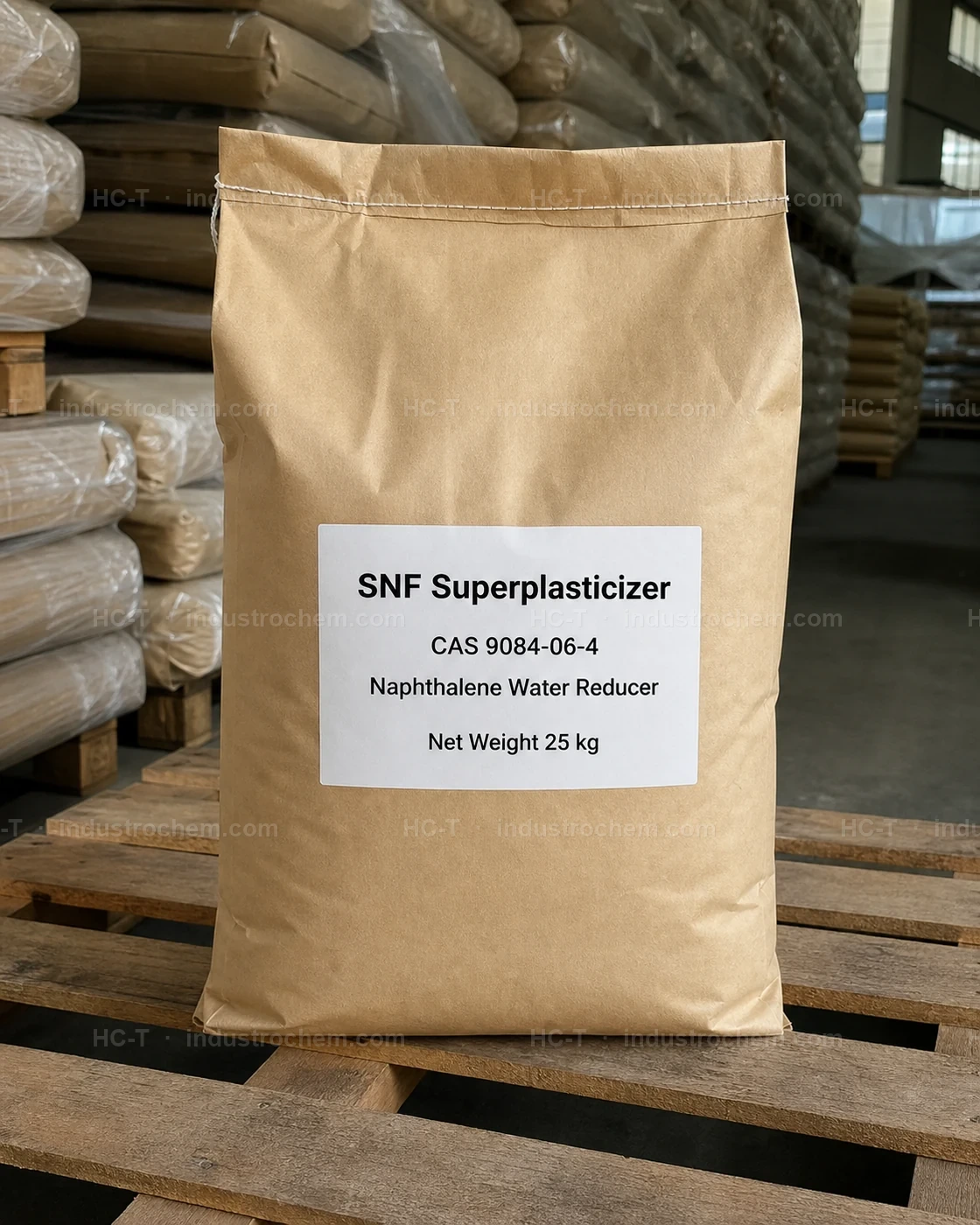
Sodium naphthalene sulfonate formaldehyde condensate (SNF), also known as naphthalene superplasticizer, CAS 9084-06-4, is a naphthalene-based concrete and mortar water-reducing dispersant. Powder and liquid grades are specified by solids, pH and cement compatibility, with COA, TDS and SDS for the agreed admixture grade.
Sodium Naphthalene Sulfonate Formaldehyde Condensate (SNF) CAS 9084-06-4
- CAS: 9084-06-4
- Synonyms: Sodium naphthalene sulfonate formaldehyde condensate; SNF; NSF; Naphthalene superplasticizer
- Einecs: Not specified (condensation polymer)
- Molecular Formula: Not specified (sulfonated naphthalene condensate)
- Grade: Concrete-admixture grade; powder or liquid form selected by solids and cement compatibility
- Package: 25 kg bags for powder grades or drums/IBCs for liquid grades; export pack is grade dependent
- Appearance: Brown powder or liquid grade
- Product family: Sulfonated naphthalene formaldehyde condensate
- Primary use: Concrete and mortar water-reducing dispersant
- Key controls: Solids, pH, density, sulphate/chloride limits and fluidity test method
- Compatibility: Validate with the intended cementitious mix and other admixtures
Product Description
Sodium naphthalene sulfonate formaldehyde condensate (SNF, CAS 9084-06-4) is a naphthalene-based dispersant used in concrete and mortar admixtures. Its purpose is to support fluidity and water reduction in a finished mix, but the actual response depends on cement composition, supplementary cementitious materials, aggregate moisture, admixture interactions and the dosage programme.
Applications
- Ready-mix and precast concrete admixtures requiring a naphthalene-based high-range water reducer.
- Mortar and grout formulations where dispersion and workable consistency are required.
- Concrete systems where established naphthalene superplasticizer chemistry is preferred over a polymeric PCE route.
- Selected pigment, dye or mineral-dispersion formulations when the grade is technically compatible.
Specification points
Confirm powder or liquid form, active solids, pH, density, sulphate/chloride limits and the test method used to evaluate fluidity. Polycarboxylate ether monomers belong to a different admixture chemistry; SNF and PCE should be compared by the real mix design rather than by a generic water-reduction claim.
Mix-design validation
Set time, slump retention, air content and early strength should be validated on the intended cementitious system. The COA confirms the supplied material; it does not replace an admixture trial.
FAQ - Technical & Supply Chain
-
Q:
How is SNF different from a polycarboxylate superplasticizer?
A: SNF is a naphthalene-based condensate dispersant, while PCE admixtures use a different polymer architecture. Their slump retention, cement sensitivity and interaction with other admixtures can differ, so they should be compared in the actual concrete mix. -
Q:
Which SNF specifications matter for a concrete-admixture buyer?
A: State powder or liquid form, active-solids basis, pH, density, sulphate and chloride limits, and the required fluidity test conditions. Cement compatibility and set-time response need confirmation through a mix trial.
Ordering & Documentation
Key information for document requests, quotations, and supply planning.
Documents
COA, TDS, SDS/MSDS and packing details are available on request.
Quotation
Send the CAS number, grade, quantity, packing preference and destination.
Sample & Supply
Support is available for samples, trial orders, bulk and repeat supply.
Storage & Shipping
Product-specific conditions are confirmed before order.
