










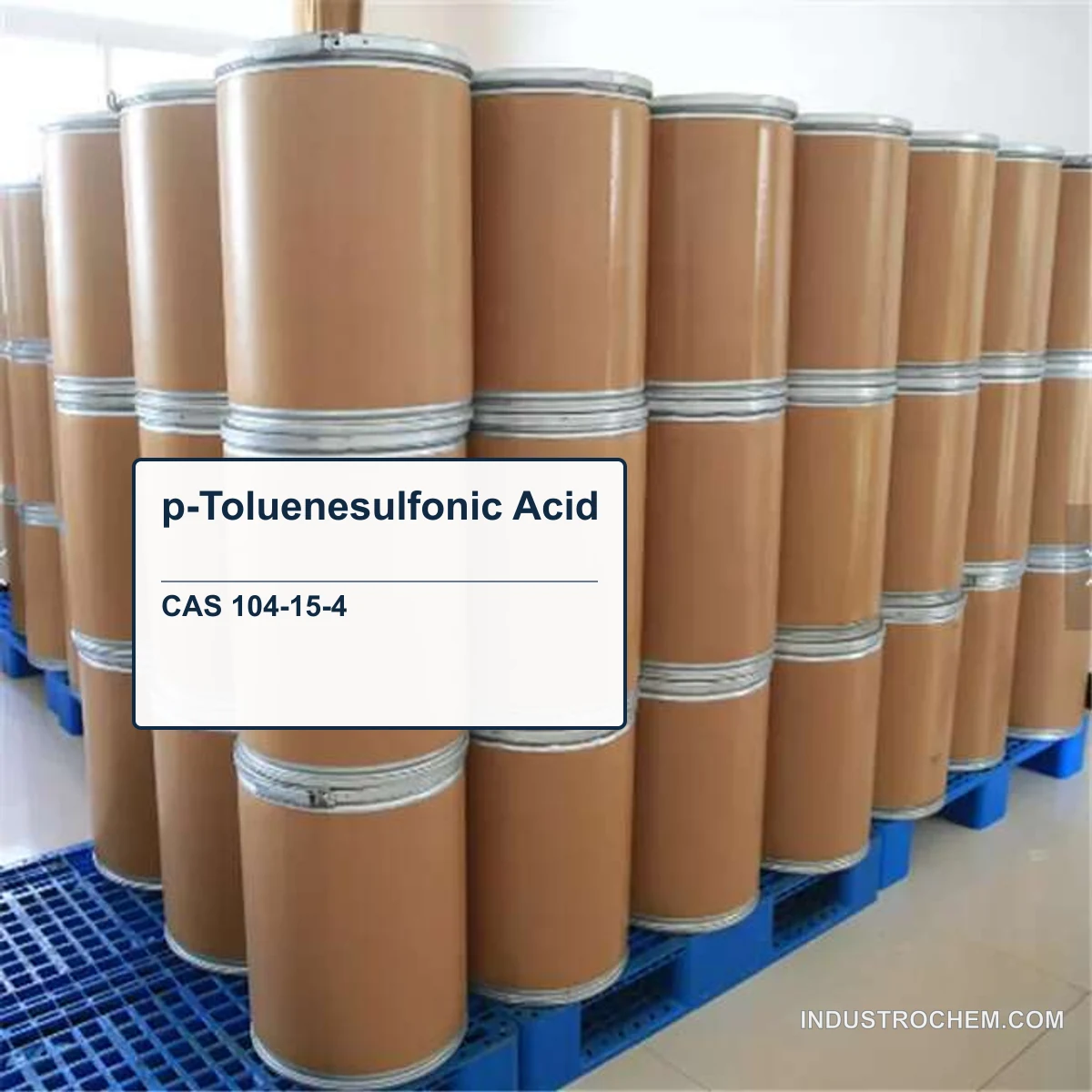
p-Toluenesulfonic Acid (PTSA), also called 4-methylbenzenesulfonic acid, is an aromatic sulfonic acid identified by CAS 104-15-4. It may be evaluated as an acid catalyst in organic synthesis when the required acid form, process conditions and material compatibility are defined. For an RFQ, state the required acid form, intended reaction, quantity, packaging, destination and document needs.
p-Toluenesulfonic Acid (PTSA) CAS 104-15-4
- CAS: 104-15-4
- Synonyms: p-Toluenesulfonic Acid; 4-Methylbenzenesulfonic Acid; Tosic Acid; PTSA; TsOH
- Einecs: 203-180-0
- Molecular Formula: C₇H₈O₃S
- Grade: State the required product-specific specification for the intended process.
- Package: State packaging and handling requirements for the product and destination.
Product Description
p-Toluenesulfonic Acid (PTSA), also called 4-methylbenzenesulfonic acid, is an aromatic sulfonic acid identified by CAS 104-15-4.
Synonyms: p-Toluenesulfonic Acid; 4-Methylbenzenesulfonic Acid; Tosic Acid; PTSA; TsOH.
Molecular formula: C₇H₈O₃S.
Molar mass: 172.20 g/mol.
CAS Number: 104-15-4.
EC Number: 203-180-0.
Physical-property requirements: confirm them against the current product-specific specification and applicable SDS.
Industrial process context
It may be evaluated as an acid catalyst in organic synthesis when the required acid form, process conditions and material compatibility are defined.
Safety review: assess handling, storage and process controls against the applicable SDS and current product-specific specification.
Technical review
CAS 104-15-4 identifies p-Toluenesulfonic Acid; any hydrate form must be confirmed separately.
FAQ - Technical & Supply Chain
-
Q:
Does CAS 104-15-4 identify anhydrous PTSA or PTSA monohydrate?
A: CAS 104-15-4 identifies anhydrous p-Toluenesulfonic Acid, while the monohydrate is commonly identified by CAS 6192-52-5. Commercial material may also be supplied as an aqueous solution. State the physical form, water basis, concentration and CAS number in the inquiry. -
Q:
Which specifications should be agreed when purchasing industrial PTSA?
A: Confirm total acidity or PTSA assay with the method, water, free sulfuric acid, color, iron, ash and relevant sulfonated isomers. Resin-catalyst, plating and synthesis uses may need different limits, so the quotation and batch analysis must use the same grade definition and analytical methods. -
Q:
What is PTSA typically used for?
A: p-Toluenesulfonic Acid is evaluated as an acid catalyst in esterification, acetalization, condensation and related organic synthesis, and in selected industrial formulation or cleaning applications. The required acid strength, hydration form and impurity limits depend on the process. -
Q:
What are the key physical properties of PTSA?
A: p-Toluenesulfonic Acid is a strong aromatic sulfonic acid with molecular formula C7H8O3S, molar mass about 172.20 g/mol and anhydrous melting point commonly around 106-107 C. It is very soluble in water and polar solvents, while the monohydrate may lose water near 100 C. -
Q:
How should p-Toluenesulfonic Acid be stored and handled?
A: Store in tightly closed, corrosion-resistant containers in a cool, dry, ventilated area away from moisture, bases, strong oxidizers and incompatible metals. Use acid-resistant equipment and PPE during handling and follow the current safety information for spill, ventilation and emergency response.
Ordering & Documentation
Key information for document requests, quotations, and supply planning.
Documents
COA, TDS, SDS/MSDS and packing details are available on request.
Quotation
Send the CAS number, grade, quantity, packing preference and destination.
Sample & Supply
Support is available for samples, trial orders, bulk and repeat supply.
Storage & Shipping
Product-specific conditions are confirmed before order.
