









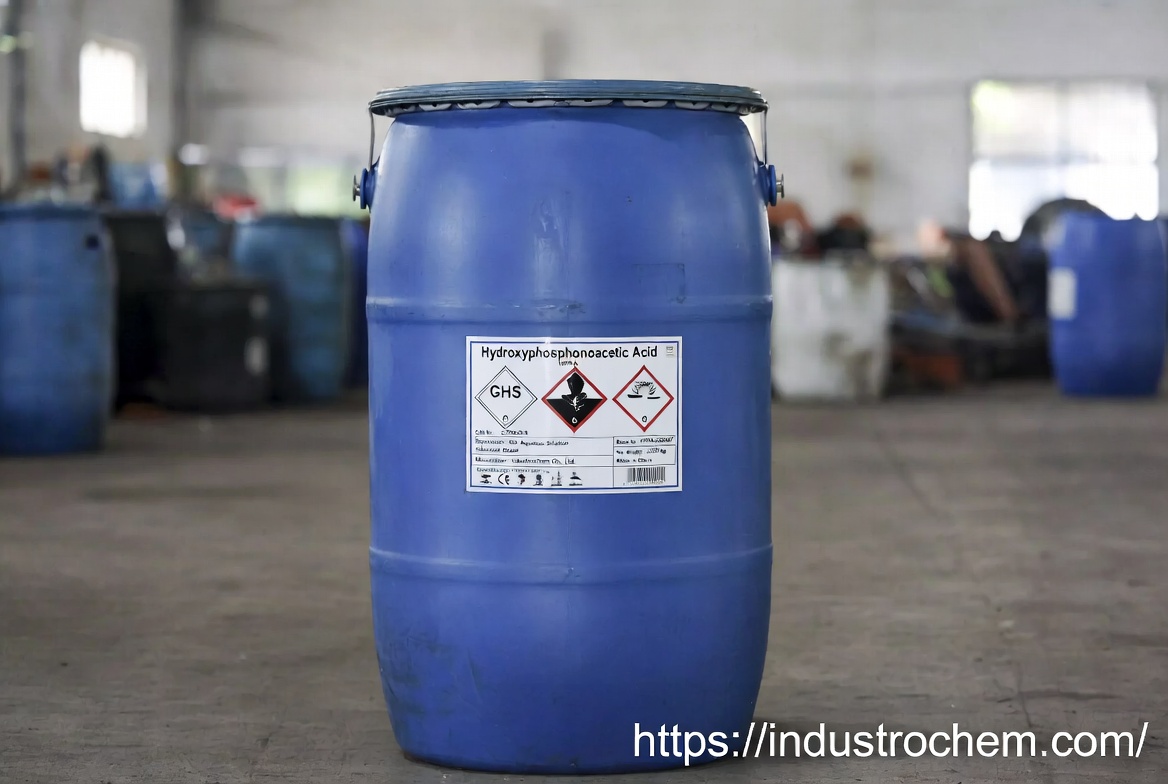
Hydroxyphosphonoacetic Acid (HPAA), also called 2-hydroxyphosphonoacetic acid, CAS 23783-26-8, a phosphonate-based water treatment chemical supplied as an aqueous solution, is positioned for mild steel corrosion inhibition in industrial water systems. Confirm the required active content and grade, then request a quotation with COA/TDS/SDS for bulk supply.
Hydroxyphosphonoacetic Acid (HPAA) CAS 23783-26-8
- CAS: 23783-26-8
- Synonyms: HPAA; HPA; Hydroxyphosphonoacetic Acid; 2-Hydroxy Phosphonoacetic Acid
- Molecular Formula: C2H5O6P
- Grade: Industrial / water treatment grade
- Package: Standard export packaging
Product Description
Hydroxyphosphonoacetic Acid (HPAA) CAS 23783-26-8 is a phosphonate-based water treatment chemical with molecular formula C2H5O6P.
Synonyms: 2-Hydroxyphosphonoacetic acid; HPA.
CAS: 23783-26-8.
Molecular formula: C2H5O6P.
It is commonly supplied as a dark amber to dark umber liquid aqueous solution.
Commercial HPAA is often supplied at about 50% active content.
It is primarily used as a corrosion inhibitor for mild steel in industrial water systems.
It is mainly used in circulating cooling water treatment and related industrial water treatment formulations.
It can also contribute to scale control in suitable phosphonate or polymer treatment programs.
It is acidic and water-miscible, with a 1% aqueous solution typically around pH 2.0-3.0.
Confirm active content, appearance, color, pH, density, and solids for the chosen grade.
Check compatibility with other phosphonates, polymers, and zinc salt in cooling-water programs.
Store in tightly closed containers in a cool, dry, well-ventilated area away from alkalis, oxidizers, and incompatible materials.
Use appropriate PPE and prevent spills or contamination.
Confirm packaging suitable for the liquid form and order quantity, and follow the current SDS.
Every batch is checked for active content, appearance, color, pH, density, and solids, with COA/TDS/SDS supplied per grade.
Confirm active content, packaging, and grade as required.
The page is an RFQ entry point and does not state stock, price, MOQ, or fixed lead time.
For an RFQ, state the intended application, required grade, quantity, packaging, destination, and document needs.
FAQ - Technical & Supply Chain
-
Q:
What is Hydroxyphosphonoacetic Acid HPAA CAS 23783-26-8?
A: Hydroxyphosphonoacetic Acid, commonly called HPAA or 2-hydroxyphosphonoacetic acid, is a phosphonate-based water treatment chemical with CAS 23783-26-8 and molecular formula C2H5O6P. It is primarily used as a corrosion inhibitor for mild steel in industrial water systems. -
Q:
What is HPAA mainly used for?
A: HPAA is mainly used in circulating cooling water treatment and related industrial water treatment formulations. Its primary role is mild steel corrosion inhibition, and it can also contribute to scale control when used in suitable phosphonate or polymer treatment programs. -
Q:
What is the common supply form and concentration of HPAA?
A: Commercial HPAA is commonly supplied as a dark amber to dark umber liquid aqueous solution, often around 50% active content. The exact concentration, color, pH, density, and solids can vary by grade, so these values should be confirmed against the selected specification. -
Q:
What pH and formulation factors should be checked for HPAA?
A: HPAA is acidic and water-miscible; a 1% aqueous solution is typically acidic, often specified around pH 2.0-3.0 depending on the source. For cooling-water programs, it is commonly evaluated with other phosphonates, polymers, and zinc salt where compatible, and final dosage should be based on water chemistry and performance testing. -
Q:
How is HPAA different from HEDP, PBTC, or ATMP?
A: These are all phosphonate water-treatment chemicals, but HPAA is especially positioned as a mild steel corrosion inhibitor rather than a broad antiscalant. HEDP, PBTC, and ATMP have different structures and performance profiles, so the selection should be based on the target water system, metallurgy, and formulation requirements.
Ordering & Documentation
Key information for document requests, quotations, and supply planning.
Documents
Tell us which documents your procurement team needs. Before an order, we will check whether the quoted source can provide them for the offered lot.
Quotation
Send the CAS number, grade, quantity, packing preference and destination.
Sample & Supply
Ask whether samples, trial quantities or repeat orders are possible. We will check each request against the sourced product and current offer.
Storage & Shipping
Product-specific conditions are confirmed before order.

