










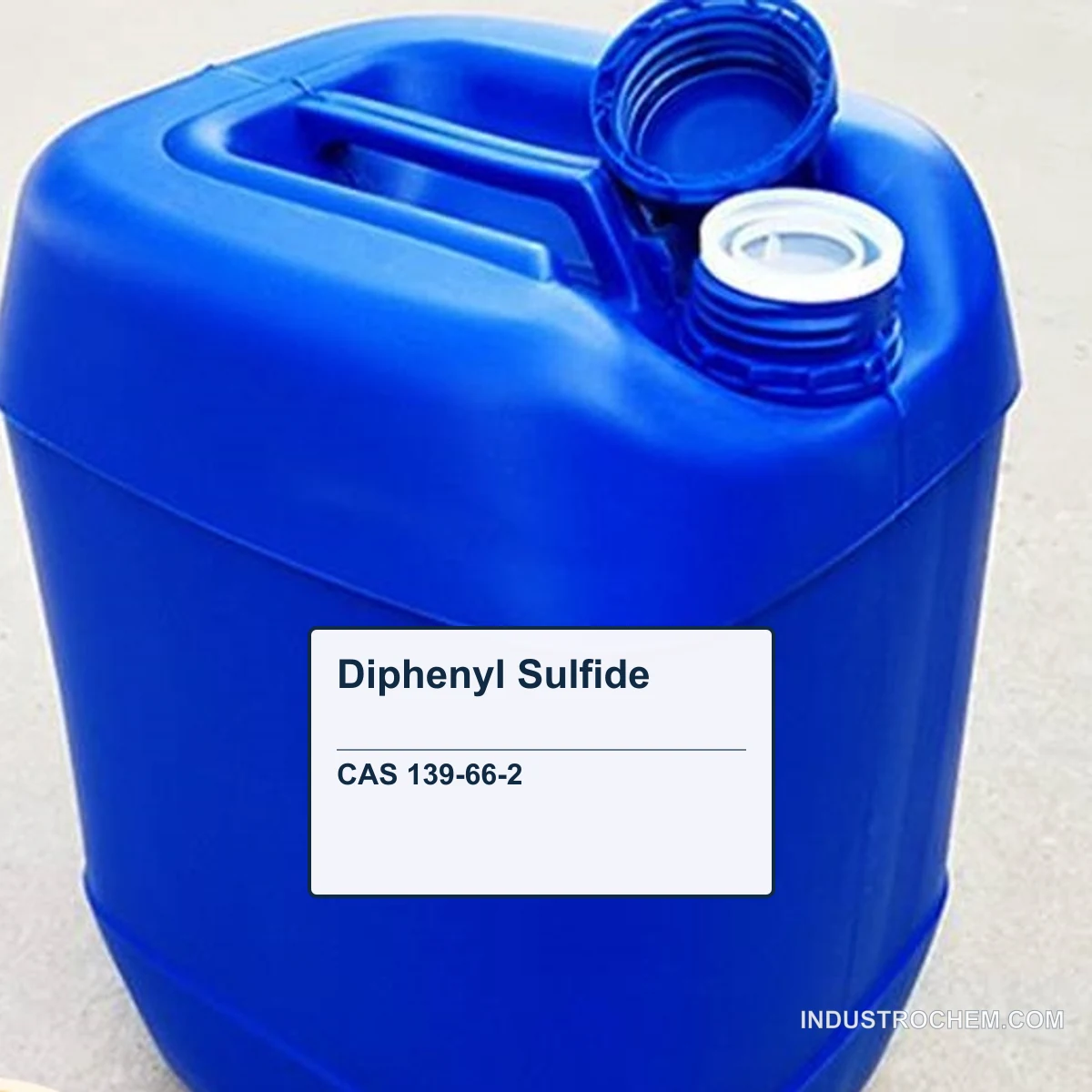
Diphenyl Sulfide is an aromatic thioether also known as phenyl sulfide or thiodiphenyl, all referring to the same chemical substance. Identified by CAS 139-66-2, it consists of two phenyl groups linked by a sulfur atom, providing chemical stability and characteristic reactivity in substitution and oxidation reactions. In industrial processing, it is primarily used as an intermediate for sulfur-containing organic synthesis, where it serves as a structural building block for downstream fine chemicals and specialty intermediates.
For industrial supply, this product is provided with customized specifications, and complete documentation including MSDS, TDS, COA, supporting bulk supply for manufacturing applications.
Diphenyl Sulfide CAS 139-66-2
- CAS: 139-66-2
- Synonyms: Diphenyl Sulfide, Phenyl Sulfide, Thiodiphenyl
- Einecs: 205-371-4
- Molecular Formula: C₁₂H₁₀S
- Grade: Industrial grade 99%
- Package: 200kg iron drum or 50kg plastic drum packaging
Product Description
Aliases: Diphenyl Sulfide, Diphenyl Sulfur, Phenyl Sulfide, Thiobenzene, Benzene Sulfide
Chemical formula: C₁₂H₁₀S
Molecular weight: 186.27 g/mol
CAS Number: 139-66-2
EINECS: 205-371-4
Melting point: -40 °C
Boiling point: 296 °C
Water solubility: insoluble in water
Density: 1.113 g/cm³
Appearance: colorless or yellowish liquid
Relative density: 1.1185
Application: Used as an intermediate for pesticides, pharmaceuticals and dyes.
Properties and stability: Toxic. Ingestion, inhalation, or skin contact and absorption can cause serious injury or even death. Wear appropriate protective clothing.
Storage: Keep sealed and store in a cool place.
FAQ - Technical & Supply Chain
-
Q:
Is Diphenyl Sulfide CAS 139-66-2 the same product as Diphenyl Disulfide?
A: No. Diphenyl Sulfide contains one sulfur atom linking two phenyl groups, while Diphenyl Disulfide, CAS 882-33-7, contains an S-S bond. State the full product name and CAS to avoid substitution. -
Q:
What is Diphenyl Sulfide used for?
A: It is used as an intermediate for pesticides, pharmaceuticals, dyes and specialty sulfur-containing chemicals. The required purity and sulfur-related impurity limits depend on the downstream reaction. -
Q:
Which batch data should be agreed for Diphenyl Sulfide?
A: Agree the GC assay and test method, water, color and clarity, density or refractive index, plus any impurity limits required by the downstream reaction. Compare values on the same basis when reviewing offers. -
Q:
What handling and safety controls apply to Diphenyl Sulfide?
A: Diphenyl Sulfide is toxic and can be absorbed by ingestion, inhalation or skin contact, so use closed transfer, ventilation and chemical-resistant PPE. Store sealed in a cool, compatible area and avoid uncontrolled release. -
Q:
What physical properties identify Diphenyl Sulfide?
A: Diphenyl Sulfide is a colorless to yellowish liquid with melting point around -40 C, boiling point around 295-296 C and density about 1.113 g/cm3. It is insoluble in water, so water content and clarity should be checked against the specification.
Ordering & Documentation
Key information for document requests, quotations, and supply planning.
Documents
COA, TDS, SDS/MSDS and packing details are available on request.
Quotation
Send the CAS number, grade, quantity, packing preference and destination.
Sample & Supply
Support is available for samples, trial orders, bulk and repeat supply.
Storage & Shipping
Product-specific conditions are confirmed before order.
